
Comparison
Weed-It vs. Drone Mapping: A Different Approach to Green-on-Brown Spot Spraying
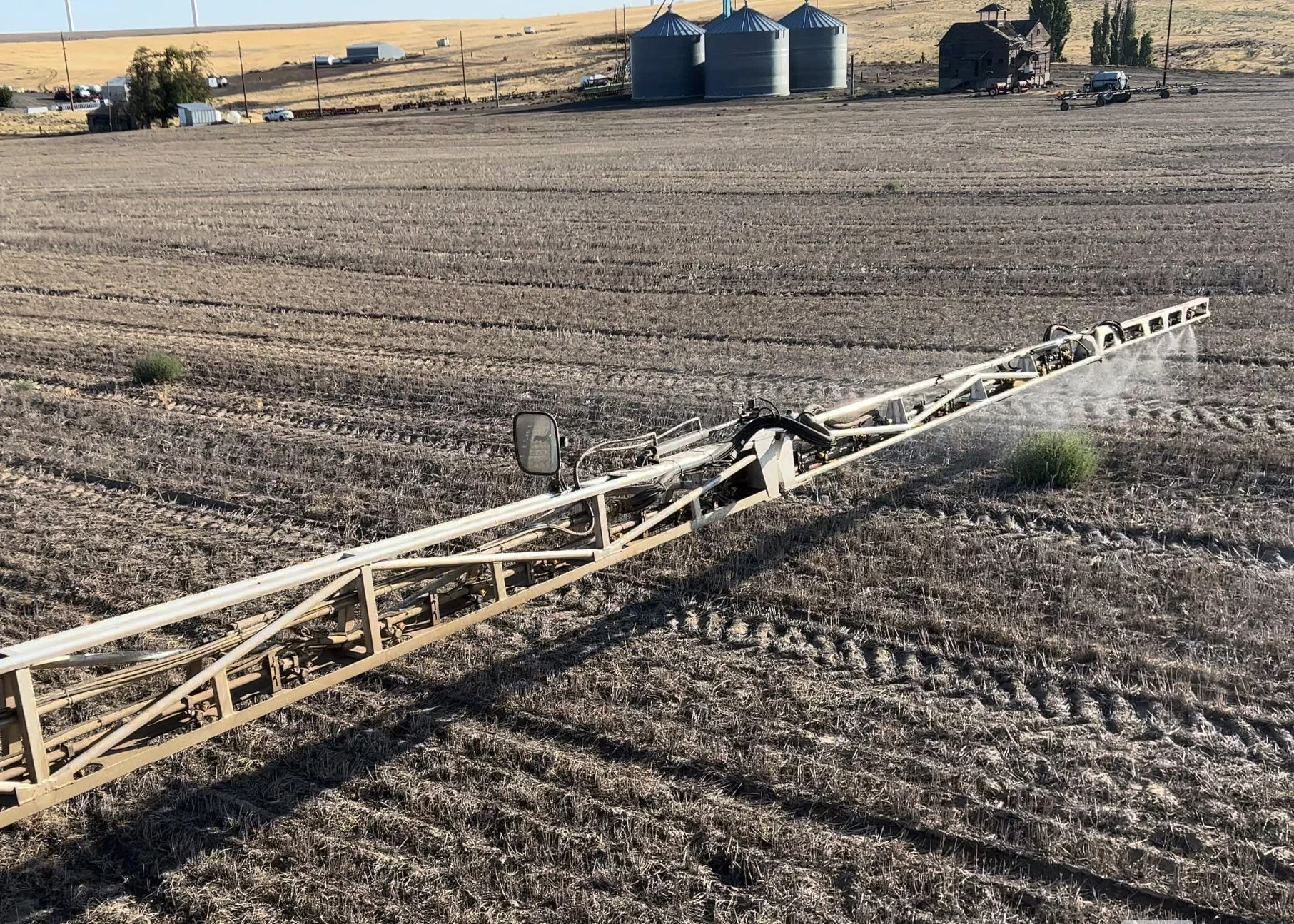
For years, if you wanted to spot spray your fallow fields, you had one option: spend $160,000 to retrofit your boom with sensors. Systems like Weed-It and WeedSeeker are impressive — they use “real-time” detection to find a weed and spray it instantly as the tractor passes over. But for many broad-acre farmers, the math just doesn’t add up. The hardware is expensive, the sensors are high-maintenance, and the retrofit is invasive.
At Agcopter, we take a different approach. Instead of putting expensive eyes in the mud, we put them in the sky. Here’s the honest breakdown of why drone mapping is replacing boom sensors for green-on-brown spot spraying.
1. The price gap: $89k vs. $160k
The biggest difference is the capital investment. To outfit a standard 120-foot boom with Weed-It or WeedSeeker, you’re looking at approximately $160,000 in hardware, harnessing, and installation. Agcopter’s complete turnkey system — heavy-lift drone, sensor, laptop, and software — is $89,000.
You save over $70,000 before you even start the engine. For a farm with 5,000 acres of fallow, that difference alone pays for two years of chemical.
2. Sensor vulnerability: the “fence post” factor
Boom-mounted sensors live a dangerous life. They’re mounted inches from the ground, moving at 12–15 mph. They get coated in dust and spray residue and need constant cleaning; uneven terrain makes boom height fluctuate, throwing off the sensor’s focus. Clip a fence post or hit a washout and you’re not replacing a nozzle body — you could be replacing the camera itself.
Our sensors fly 200 feet in the air. They never touch the mud, never collect spray residue, and never clip a fence post.
3. Detection: the stubble problem
A sensor on a bouncing boom looks at the field from ground level. Agcopter captures a stable, top-down view above the crop residue before you spray — a very different vantage point, and a smooth one that avoids the “boom bounce” of a sensor riding the boom. Two ways of looking at the same field; we’ll let you judge which fits yours.
4. The “standby” problem
With a real-time system you’re spraying blind — you don’t know if a field has 5% weed pressure or 50% until you’re driving over it. So you keep a water-truck driver on standby at the field edge, just in case. Agcopter maps the field before you spray. The software tells you: “this field needs exactly 840 gallons.” Send the truck once, fill up, and put the driver back to work.
5. No plumbing upgrades required
Competitor systems often require specific Pulse Width Modulation (PWM) nozzle bodies to work correctly. If your sprayer doesn’t have them, add another $40,000 to the bill. Agcopter is universal: we generate industry-standard prescription maps that plug directly into the monitor you already own (John Deere, Raven, Trimble). You don’t need fancy nozzles — we optimize the map for your existing boom sections to deliver 70%+ savings immediately.
6. The “married to the metal” problem
Bolt $160,000 of sensors onto a sprayer and that technology is effectively married to that machine. Want to trade sprayers next year? You either lose your investment or pay thousands in labor to strip and reinstall. And a boom-sensor system only works on one machine — need two sprayers to beat a rainstorm, and you’re buying a second $160,000 system.
Agcopter’s system is independent of the iron. Map a field once and load that file into any sprayer in your fleet. Running three sprayers today? No problem. Trading your sprayer next week? No problem. The map — and the savings — goes wherever you go.
The smart money is on the drone
Both systems accomplish the exact same goal: they kill green weeds on brown dirt. The difference is that one requires you to hang $160,000 of fragile electronics on a bouncing boom, while the other does the same job for half the price, using any sprayer you own.
Don’t overpay for the same dead weed. Calculate your ROI with Agcopter →